Portfolio demonstration · E-commerce platform
Noon E-commerce Platform
A portfolio demonstration examining the product and engineering decisions behind a connected commerce platform. It shows how the buying experience and operational tools can share one dependable foundation.
- Evidence type
- Portfolio demonstration
- Who it serves
- Customers purchasing online and the teams responsible for catalogue, inventory, orders, and fulfilment.
- Maxspace role
- Product strategy, UX decisions, and full-stack implementation
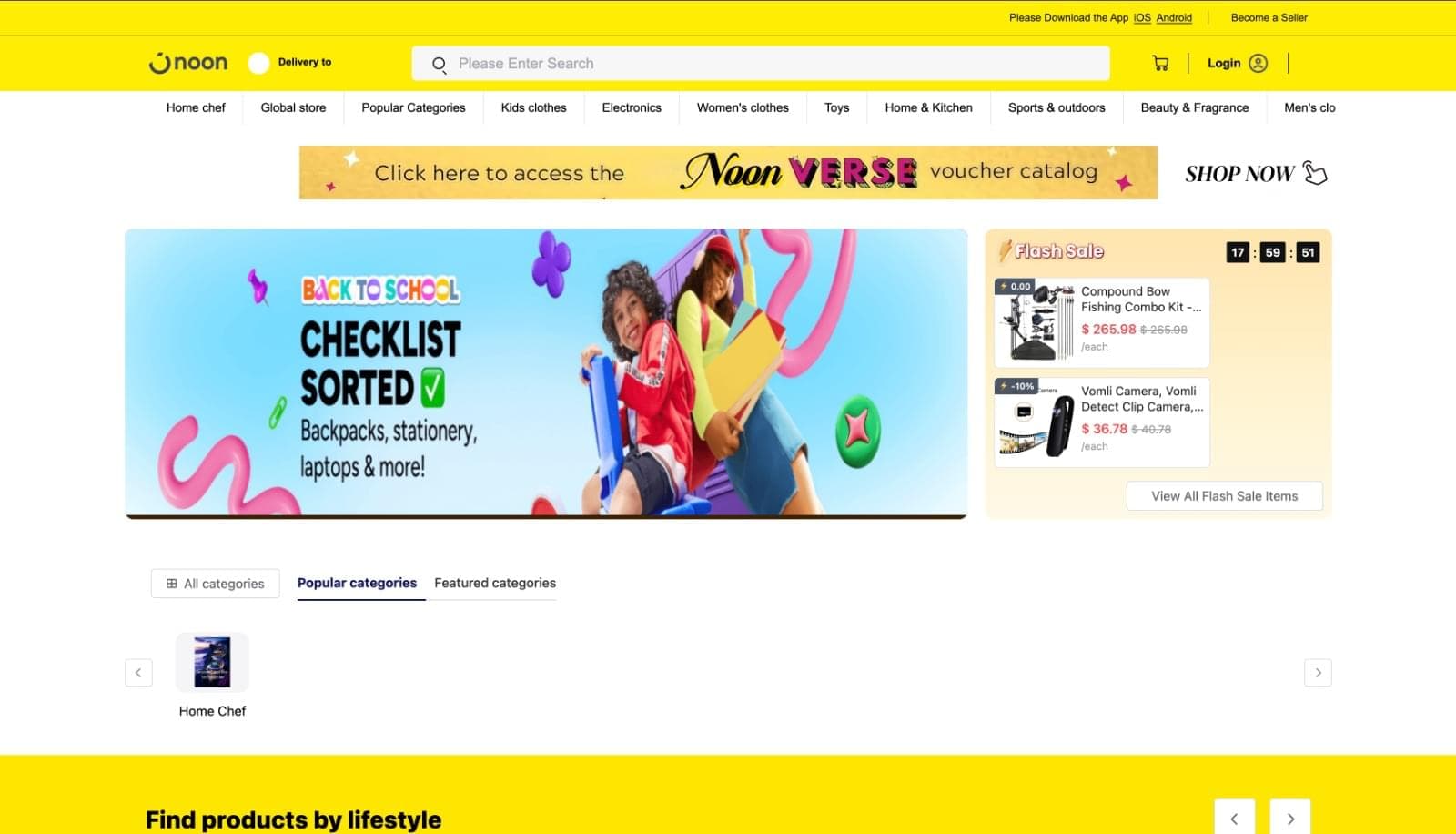
The product and its operating context
This portfolio demonstration examines commerce as a connected operating system rather than a storefront alone. Every customer action has an administrative and data consequence behind it.
Product
E-commerce platform
Users
Customers purchasing online and the teams responsible for catalogue, inventory, orders, and fulfilment.
Scope
Responsive storefront, Customer accounts, Cart and checkout, Product and inventory administration, Order management.
Classification
Portfolio demonstration. This classification defines what the case study does—and does not—claim.
The operational problem behind the interface
A commerce experience only works when product discovery, accounts, checkout, orders, and administration operate as one reliable system.
Project goals
- Help customers move from product discovery to purchase without avoidable friction
- Protect consistency across customer, catalogue, cart, and order data
- Give administrators clear control over the work behind each transaction
Evidence boundary: No real client operation, payment provider, fulfilment policy, or production demand profile was available. Those decisions remain explicit production requirements rather than implied capabilities.
What needed to be understood before solution decisions
Discovery was framed around the full purchase lifecycle: how products are found, how buying state changes, what administrators must control, and where incomplete transactions or inconsistent records create risk.
- Mapped the journey from product discovery through account, cart, checkout, and order history
- Identified the administrative responsibilities behind catalogue and order operations
- Prioritized the transaction path before secondary merchandising features
- Defined state changes that needed server-side validation
- Separated demonstration assumptions from requirements that would need a real operator's approval
A high-level view of the system
A component-led frontend and REST API separate customer-facing concerns from domain rules. Validation and authorization sit on the server, while distinct product, customer, cart, and order models make state changes easier to reason about.
Customer application
A responsive Angular interface handles discovery, account, cart, checkout, and order views while keeping business rules on the server.
Application API
Node.js and Express expose defined commerce operations and provide one place for validation, authorization, and order-state rules.
Commerce data
MongoDB separates products, users, carts, and orders while supporting the nested catalogue information used by the interface.
Identity and access
Authenticated customer actions and restricted administrative operations are treated as different permission contexts.
External boundaries
Payments, media storage, email, and fulfilment would remain provider integrations with explicit failure and reconciliation behavior in production.
Deployment
The frontend, API, database, secrets, and provider configuration are treated as separate production responsibilities.
Why the stack was used
Technology choices are described in the context of this project. They are not universal recommendations for every product.
Angular
Selected for a structured, component-led application with shared services, form handling, routing, and predictable patterns across customer and administrative flows.
Node.js and Express
Used to keep API development in the JavaScript ecosystem while centralizing transactional validation and integration boundaries.
MongoDB
Used for the demonstration's catalogue-oriented data and evolving product attributes. A production decision would also consider reporting, transaction, and inventory consistency requirements.
REST APIs
Chosen to make customer and administration operations explicit, testable, and separable from interface state.
Token-based authentication
Suitable for demonstrating protected API operations, subject to production review of storage, expiry, renewal, revocation, and provider choices.
Features organized around responsibility
Customer journey
- Product discovery and search
- Product detail
- Account access
- Cart and checkout
- Order history
Commerce administration
- Catalogue management
- Inventory context
- Order status
- Customer records
- Operational controls
Transaction integrity
- Validated inputs
- Explicit order states
- Protected actions
- Clear error feedback
- Consistent price handling
Responsive experience
- Adaptive navigation
- Flexible product grids
- Touch-friendly forms
- Mobile checkout sequence
- Readable order summaries
Interface decisions that reduce uncertainty
Information hierarchy
Product value, price, availability, and the next buying action receive priority over secondary detail.
Workflow clarity
Each step exposes current state and the next valid action so customers are not forced to infer whether a change succeeded.
Error prevention
Form constraints, server validation, persistent cart state, and explicit totals reduce avoidable transaction mistakes.
Responsive behavior
The purchase journey becomes a focused single-column sequence on smaller screens instead of a compressed desktop layout.
Accessibility direction
Labels, keyboard access, focus visibility, semantic controls, and understandable feedback form the baseline for production review.
Where the difficult decisions sit
Keeping commerce state consistent
Cart, order, product, and customer information change at different moments. Operations were kept behind explicit API actions instead of allowing the interface to update related records independently.
Separating customer and operator concerns
The same commerce data serves different responsibilities. Routes, permissions, and interfaces were separated so convenience in one context did not weaken control in another.
Handling incomplete transactions
Order states and errors were made explicit so abandoned or failed steps could be identified rather than appearing as successful purchases.
Responsive product density
Product-rich screens were reorganized around decision priority, preserving useful information without shrinking controls below practical touch sizes.
How production risk would be addressed
Quality assurance
- Validate the complete discovery-to-order path and important failure states
- Test customer and administrator permissions independently
- Check price, quantity, cart, and order-state consistency
- Review forms, empty states, loading states, and error recovery
- Verify agreed browsers, breakpoints, keyboard access, and readable focus states
- Use provider sandbox environments before any production payment testing
Security considerations
- Authenticate protected customer and administrative actions
- Authorize restricted operations on the server rather than relying on hidden interface controls
- Validate and normalize catalogue, account, cart, and order inputs
- Keep secrets and provider credentials outside source code
- Avoid storing raw payment details inside the application
- Review session, token, logging, and personal-data retention decisions before production
These are product-specific considerations and review activities. They are not claims of certification, regulatory approval, absolute security, or completed production assurance.
Optimize against real usage, not abstract scores
Catalogue loading
Use pagination or incremental loading for large catalogues instead of returning every product at once.
Search and filtering
Index the fields used by real search and filter patterns, then validate against representative catalogue size.
Images
Deliver appropriately sized formats, preserve dimensions, and defer media outside the initial viewport.
Application bundles
Separate routes and administrative code where the framework and hosting model support it.
Caching
Cache public catalogue data only where freshness and inventory rules allow; never treat transaction state as static content.
What the product is designed to improve
- A buying flow with fewer unclear transitions
- A more manageable path from catalogue changes to order handling
- A technical structure that can accept additional commerce rules
Lessons and future direction
Commerce architecture should follow transaction and fulfilment rules, not only the storefront design. The next responsible step would be operator discovery around payment settlement, stock reservation, tax, cancellation, returns, fulfilment, monitoring, and reconciliation.
The outcome statements above describe intended operational improvements. No unverified KPI, revenue, adoption, or client result is implied.
Project gallery
The interface in context
Screens are shown without decorative device frames so the information hierarchy and product behavior remain visible.


Tools grouped by responsibility
Frontend
Backend
Database
Authentication
Infrastructure
Tools
Planning something similar?
Discuss the business problem before committing to a solution
Share the current workflow, users, integrations, constraints, and intended change. We will identify what must be validated before responsible scope or architecture decisions are made.
Discuss your project